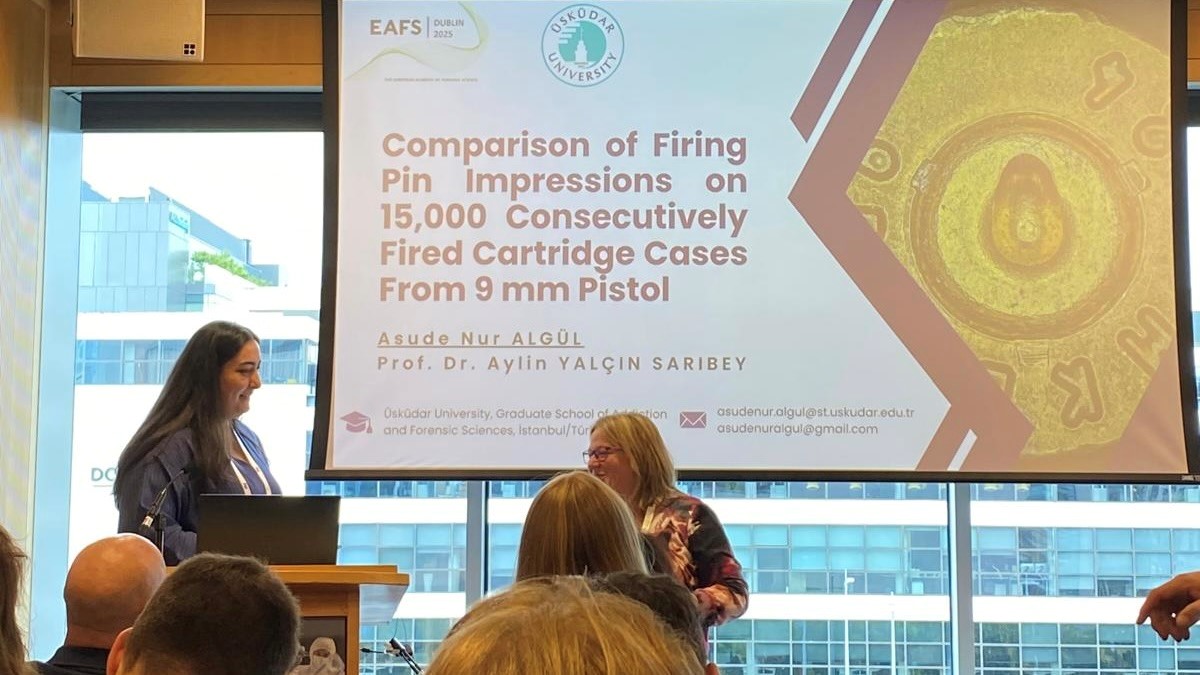
How 15,000 Rounds Change a Firing Pin: New Insights into Toolmark Evolution
Overview
When a firearm discharges, its firing pin leaves microscopic individual characteristics on the cartridge case primer. Over prolonged use, mechanical wear gradually alters these characteristics, potentially affecting forensic comparisons.
A study conducted by Asude Nur Algül and Aylin Yalçın Sarıbey from Üsküdar University investigated how 15,000 consecutive rounds influence firing pin impressions and the reliability of firearm identification.
Study Setup & Methodology
The researchers tested a TİSAŞ 9 mm Parabellum semi-automatic pistol using MKE 9×19 mm Parabellum ammunition.
Firing Protocol
15,000 consecutive rounds were fired under controlled laboratory conditions.
Sampling Strategy
A total of 260 cartridge cases were collected, including 10 baseline samples and additional samples every 600 rounds.
Dual-Method Analysis
Traditional Microscopy
Cartridge cases were examined using a stereo microscope and comparison macroscope to document morphological changes in firing pin impressions over time.
Digital 3D Toolmark Analysis
All cartridge cases were analyzed with the BALİSTİKA® system to calculate 3D similarity scores between different firing intervals.
Key Findings
Progressive Wear & Morphological Deformation
Continuous firing of 15,000 rounds produced measurable physical deformation of the firing pin tip.
Impact on Visual Identification
Increasing wear altered microscopic striations and impression contours, making direct comparison with baseline samples more challenging.
Digital Similarity Score Variations
BALİSTİKA® similarity scores gradually changed throughout the firing sequence, reflecting the evolution of firing pin surface characteristics.
Combined Examination Improves Reliability
Integrating traditional comparison microscopy with automated 3D digital analysis provides a more objective and reliable approach when examining heavily used firearms.
Publication & Conference Details
| Conference Presentation | Presented by Asude Nur Algül at the European Academy of Forensic Science Conference (EAFS 2025), Dublin, Ireland. |
|---|---|
| Journal Publication | Forensic Science International, Volume 381 (2026), Article 112841. |
| DOI | 10.1016/j.forsciint.2026.112841 |